
13 Oct What inflatable tank capacity do you actually need?
Choosing the wrong tank size is more common than you’d think.
An undersized tank can’t keep up with the operation’s water consumption. An oversized one means hauling and setting up more than you need. Either way, the wrong capacity costs you.
So, what Inflatable Tank capacity do you actually need?
The answer comes down to four variables: the area to be covered, the loading method, your fire pump’s flow rate, and how easily the tank can be transported to the deployment site.
An incorrectly sized inflatable tank creates two different problems depending on which way the error goes: insufficient infrastructure, if the usable volume does not cover the water consumption of the operation, and unnecessary logistics, if a larger unit than the operation requires is transported and set up.
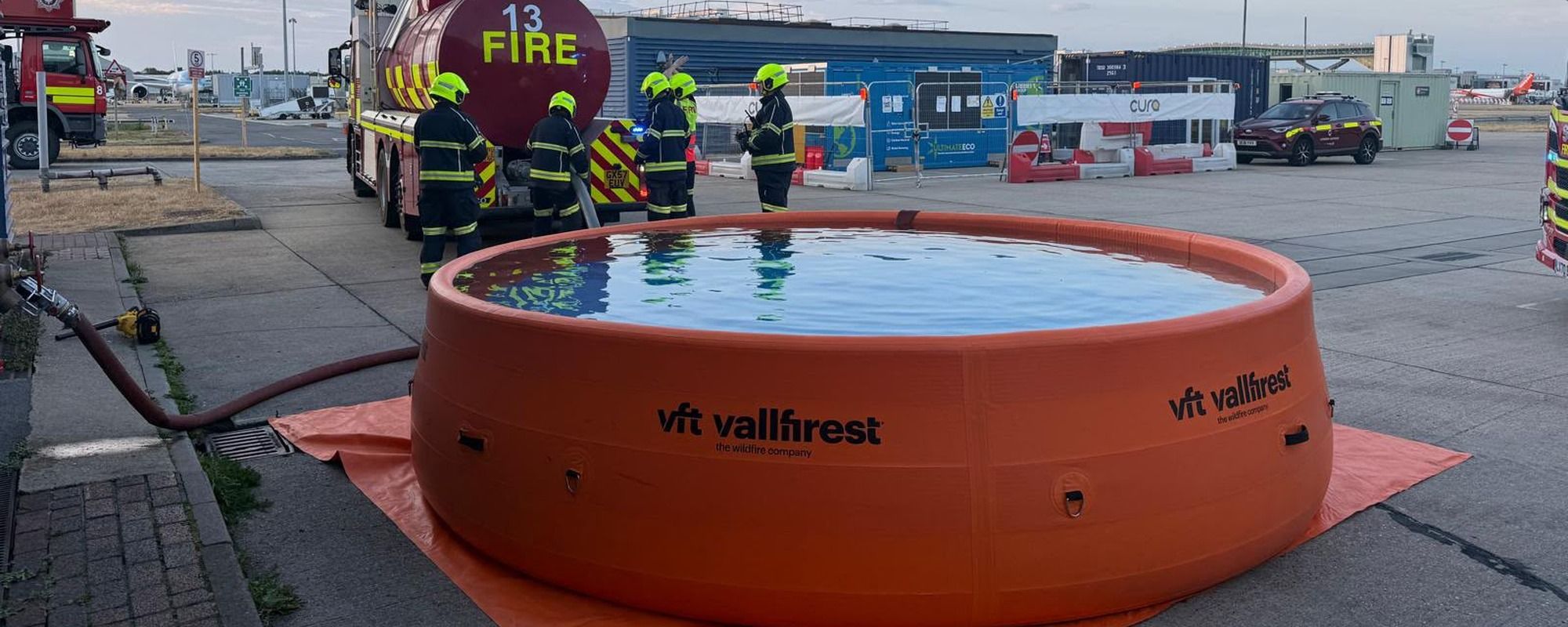
Vallfirest inflatable water tanks are designed to create remote water points, with much shorter and simpler set-up than traditional metal frame tanks and more efficient performance than floating-collar tanks. The right capacity depends on four variables: the area to be covered, the loading method, the flow rate of the fire pump and the ease of transport required by access to the deployment site.
Vallfirest inflatable tank range: technical specifications
The range covers five nominal capacities, from 3,000 to 56,000 litres, made of 2,600 g/m² PVC with a double protective layer on the top ring against bucket impacts and a blue double-layer floor.
How to choose the right capacity
Applying the four variables above to the specification table, the selection comes down to checking four specific points:
- Area to be covered: the higher the water consumption between refills, the greater the usable capacity of the tank must be.
- Loading method: for ground loading by fire pump, any diameter is valid. For aerial loading with a helicopter bucket or with a drone loading system such as the Water Hog from the VFT Aerial division, the relevant variable is the tank height, not the diameter: the 25,000 and 56,000 L models, at 2 m high, allow practical use of aerial buckets.
- Fire pump flow rate: a low flow rate means longer filling times when the tank has to be refilled from an external source; it is advisable to compare the available flow rate with the usable capacity before oversizing.
- Ease of transport: if access is on foot, the 3,000 and 7,000 L models (31–43 kg, folded ≤90x45x45 cm) are the only ones that can be carried without mechanical means; the 12,000 L model (78 kg) is already close to the limit of what can be handled manually, and from 25,000 L (105.5–173.5 kg) deployment requires a vehicle and several operators.